

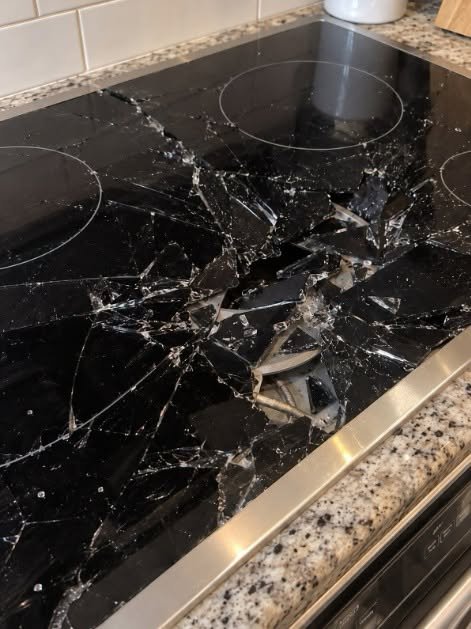
Your Glass Top Stove Can Shatter If You Make This Mistake

The Hot Lid Mistake You Should Avoid
Here's the habit I really want you to remember:
Don't place a hot lid directly on your glass cooktop.
This isn't simply an internet kitchen rumor. Whirlpool's ceramic-glass cooktop guidance specifically warns against leaving a hot lid on the cooktop.
According to Whirlpool, as the cooktop cools, air can become trapped between the lid and the cooking surface. That can create a situation where the ceramic glass could break when the lid is removed.
That's a pretty good reason to change the habit!
Instead of placing the lid directly on the cooktop, put it on a heat-resistant trivet, cooling rack, or another surface designed to hold hot cookware, while following the recommendations for your particular appliance.
It's a tiny change.
But considering how expensive a cooktop can be to repair or replace, it's one I'm happy to make.
Why Can a Hot Lid Be a Problem?
The issue isn't simply that the glass is "afraid" of heat.
Your cooktop is specifically designed to get hot.
The concern is what happens when a hot object and the glass surface interact in a way the appliance wasn't designed to handle.
A hot lid can trap heat and, as things cool, create a tight seal or trapped air pocket between the lid and the cooktop. Whirlpool warns that this can contribute to the ceramic glass breaking when the lid is removed.
There can also be differences in temperature across the cooking surface. One area might be extremely hot while another area is considerably cooler.
Ceramic glass is engineered to cope with normal cooking conditions, but sudden or uneven stresses can still cause problems.
So the safest approach is wonderfully simple:
Don't use your glass cooktop as a resting place for hot cookware or lids.
Give hot items their own heat-resistant resting spot instead.
It's Not Just Hot Lids You Need to Watch
Once you know about the lid issue, you start noticing how many other things we casually place on a stovetop.
Heavy Pots and Pans
A glass cooktop isn't a countertop.
Even if a heavy pot doesn't look particularly dangerous, dropping it onto the surface can cause serious damage.
The safest habit is to lift cookware and place it down gently rather than dropping, tossing, or sliding it across the glass.
This becomes especially important with cast-iron cookware and other heavy pots.
If you need to move a heavy pan, lift it carefully rather than dragging it.
Rough or Dirty Cookware
The bottom of your cookware matters, too.
A rough, damaged, or gritty pan can scratch the cooktop when it's moved around.
Even tiny particles of food or debris trapped underneath cookware can act like sandpaper when a pan is dragged across the surface.
Before placing cookware on the glass, make sure the bottom is reasonably clean and free of anything that could scratch it.
Pans That Are Being Dragged Across the Surface
This one is so easy to do.
You finish stirring, decide the pan needs to move slightly, and instead of lifting it, you give it a little shove.
Then another.
And another.
Before long, that beautiful smooth cooktop has scratches that weren't there before.
Lift instead of slide whenever possible.
It takes an extra second, but your cooktop will thank you.
What Should You Use Instead of the Cooktop as a Resting Place?
This is where a little preparation makes life much easier.
Keep a heat-resistant trivet or suitable cooling rack somewhere close to the stove.
That way, when you're cooking and suddenly need somewhere to put a hot lid, you don't have to think about it.
The trivet is right there.
Hot lid comes off.
Lid goes on trivet.
Problem solved!
Just make sure whatever you're using is actually rated for the temperature of the cookware you're placing on it and is suitable for the surface where you intend to use it.
And always check your cooktop manufacturer's instructions, because recommendations can vary by model.
What About Putting a Hot Pan on the Cooktop?
